

強制單車頭盔立法與政府綠色出行目標背道而馳 單車徑設計缺陷導致單車意外上升
此文件只有英文版。
(Hong Kong, 14 January 2023) Jointly organised by LocoBike and Street Reset, a press conference was held last week at the Shatin Science Park Convention Centre in response to the government’s Mandatory Cycle Helmet Law proposal. LocoBike conducted a public opinion survey with over 2,000 regular cycle users and found that 88% of the respondents do not see the need to wear helmets. Advocacy group Street Reset also presented research on cycle collision data and provided a series of design and policy recommendations for the government to improve safety on cycle tracks. (Presentation Slides of the press conference (in Chinese only) are viewable here: http://bit.ly/3iEEi6Y) 88% of regular cycle users do not see the need to wear helmets
The opinion survey was conducted by LocoBike between 18 November and 31 December 2022 via an online questionnaire, which received a total of 2,027 responses. Amongst the respondents, who are all self-identified regular cycle users, 91% said they did not wear a helmet the last time they cycled. For their reasons for not wearing a helmet, 88% indicated that they did not think it was necessary or they did not carry one.
Founder of LocoBike, Ken CHING Chun-Ho, said that many people use bicycles as a means of short- distance travel precisely because of their convenience and flexibility. Hence, the legislation will greatly reduce people’s desire to use bicycles as a means of everyday transport.
Numerous overseas precedents suggest that mandatory cycle helmet laws led to a rapid decline in cycling usage. In fact, only three jurisdictions in the world (United Arab Emirates, Australia and New Zealand) have implemented comprehensive mandatory helmet regulations. Both Australia and New Zealand have since recorded significant declines in cycling usage, with the impact lasting up to ten years.,,,
Mr CHING also said, "Although government figures have shown an increase in the overall number of cycling collisions in the past two years, we found that the number of serious collisions only reverted to the 2015 level, and the increase may be largely due to an overall increase in cycle usage during the hike of the Pandemic.” Given the government has been promoting green mobility and invested in building more cycle infrastructure in recent years, mandating cycle helmets by law will be “putting the cart before the horse”.
Nearly 85% of cycling collisions involved minor injuries, with only about 30% of fatal or serious injuries occurring on cycle tracks
Through various Access to Information requests to the Transport Department, Street Reset has obtained the anonymised details and geo-location of each cycle collision that happened from 2017-2021. This five-year data was analysed and collated to produce a profile of incidents involving cycling casualties and to carry out a crash black spot analysis of cycle track junctions to help identify safety issues and design hazards on cycle tracks.
Street Reset researcher Kenneth WONG Kiu-Ho noted three observations from the data:
1. Although the overall number of cycling collisions rose to a record high in these two years, the number of fatal and serious collisions was similar to that in 2015-16.
2. The total number of cycle collisions in the five-year period was 11,190, of which about 1,700 (about 15%) were fatal or serious collisions.
3. According to TD's collision location coordinates, over 60% of fatal or serious cycling accidents occurred on carriageways, while only 33% happened on cycling tracks.
Defective cycle track design poses safety hazards
Justin YIM, founder of Street Reset, said that while cycling collisions are direct results of human error, they are also attributable to unsafe conditions found on cycle tracks and carriageways. For example: Many cycle crossings along the cycle tracks are hidden from drivers’ views, making it harder for drivers to see that bikes may be passing directly over them.
Wide junctions adjacent to cycle tracks allow vehicles to turn without much need to slow down, increasing the likelihood of collisions.
Many sections of the cycle tracks are disconnected and disjointed. One example can be found on Ting Kok Road and Castle Peak Road, where some sections of the cycle track abruptly terminate at the middle of 70 km/h carriageways, posing a danger to cyclists.
In addition, many of the old grade-separated crossings along cycle tracks are full of design flaws, including inadequate sight distance, sharp bends at the bottom of the ramps and the risk of collision with hard objects at the roadside.
Current government’s cycle track standards date back to 1970s, requires overhaul
To address the safety issue of hidden cycle crossings, Mr YIM proposed revamping their designs by giving cyclists a clear right of way through give-way lines for vehicles or dedicated cycle signals. Coloured road markings across crossings and raised road ramps around junctions can also help direct drivers to slow down and yield to cyclists (see picture below). These measures could help cyclists can cross the road in a visible, safe and direct manner, and have been widely adopted overseas, including in the UK, Singapore and Queensland, Australia.
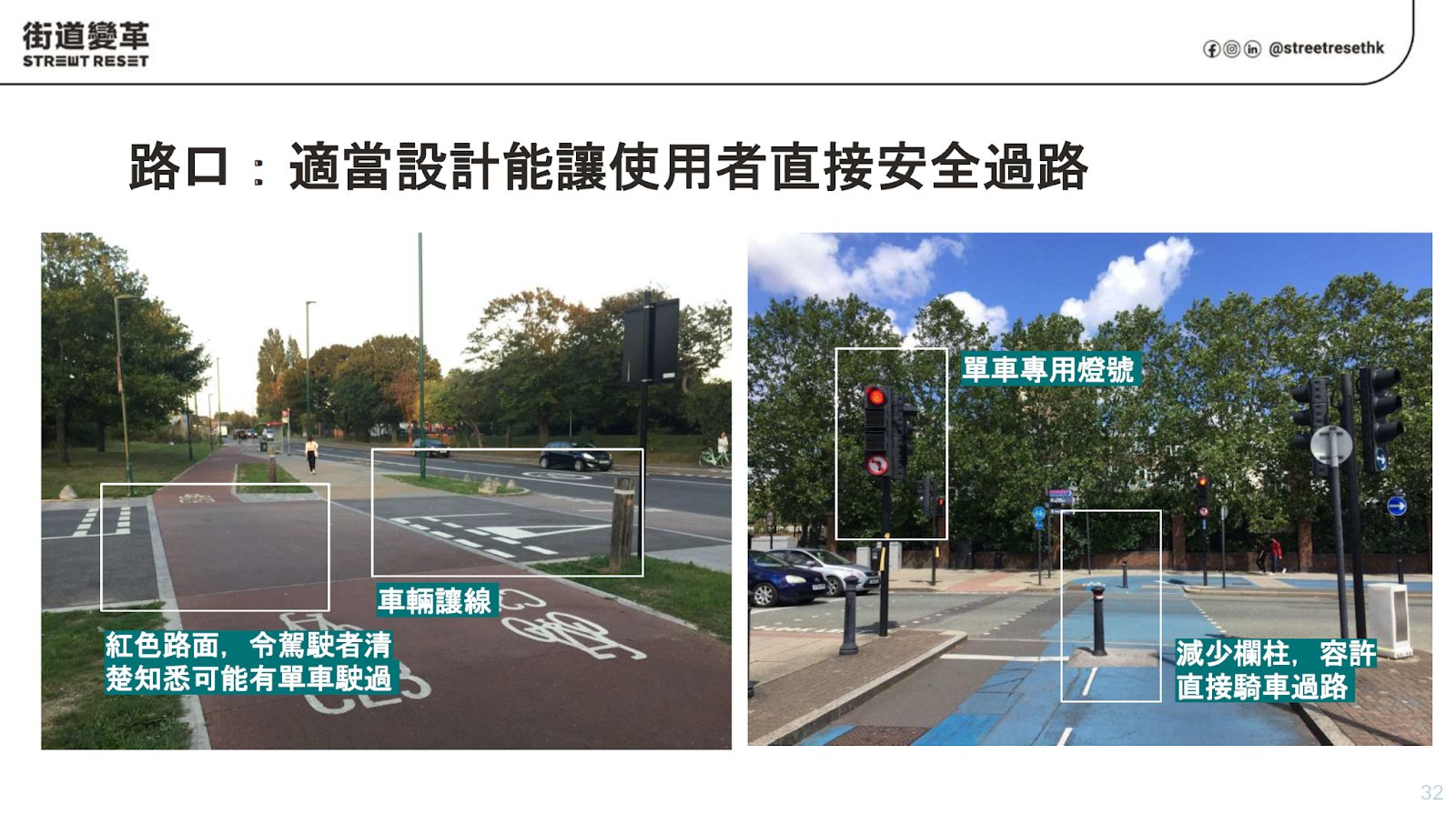
Mr YIM also found that the government’s current standards related to cycle tracks are still based on overseas standards established in the 1970s. The Government should update the existing cycle track design standards in reference to the latest overseas design standards, and systematically improve the existing cycle tracks in order to improve the safety of cycle tracks at the root.
More than 4,000 people cycle daily for utility trips within Tai Po
Cycling tracks in Tai Po and Sha Tin are among the more developed areas in Hong Kong and have been in use for a longer period of time. Ben TAM Yi-pui, member of the Tai Po District Council, said, "According to our survey statistics, more than 4,000 people use bicycles for transport every day in Tai Po, and respondents reported potential hazards at some sections of the tracks. The government should conduct a detailed analysis of the cycle collision data to determine concrete steps to address cycle safety, rather than going for a broad-brush approach with helmets to undermine the public's habit of cycling.”
Shatin District Councillor Osman CHENG Chung-Hang also said, "Although helmets can reduce the severity of collisions, they cannot reduce the incidence of collisions itself. Given that the majority of serious cycling collisions happened on the carriageways, we should reflect on whether it is the poor design of cycle tracks that led to more cycle usage on roads. We suggest that the Government should focus on improving road design and introducing cycling-friendly policies.
Shatin District Councillor Mr Johnny CHUNG Lai-him believes that education is the best way to improve the cycling habits of the general public, “Just as the parents’ driving attitude directly affects that of their children when they grow up, so does the use of bicycles.”
Cycle Alliance says the legislation will 'do a disservice with good intentions'
Hong Kong Cycling Alliance spokesperson CHAN Ka-Leung believes that good cycling-friendly policies, good planning and cycling education are necessary to truly improve cycling safety. He mentioned that in the Netherlands, a cycling-friendly country, only a fraction of people wear helmets for cycling. He believes that forcing people to wear helmets on bicycles would be “doing a disservice with good intentions”. He added, in some countries, such as Australia, where helmets are mandatory, the overall rate of cycling use has dropped, and “the loss of cycling opportunities has contributed to increased mortality from noncommunicable diseases".